 Massachusetts Workers Compensation Lawyers Blog



Su Warren v. Williams & Parsons PC, a case from the Supreme Court of the State of Idaho, involved a claimant who was injured when a car crashed into the wall directly outside of her office, causing her to be thrown across the room. She immediately felt pain in her face and hand and suffered from dizziness. Her primary care physician (PCP) noted subtle evidence of cognitive impairment and a decrease in her ability to concentrate.
 X-rays of her hand were negative for physical injuries and a head CT scan showed no abnormalities. Her doctor stated that she had nearly fully recovered but recommended continued physical therapy. After completing physical therapy, she had made a significant recovery from her injuries, according to her PCP.
Around the same time her doctor found near complete recovery, her employer fired her on grounds that her work had deteriorated beginning three months prior to the accident. She had been earning $14 per hour plus overtime during tax season.
Continue reading
 Claimant slipped on a wet floor at the medical center and seriously injured her right leg, hip, lower back, and neck. She quickly applied for workers’ compensation benefits and was awarded around $580 per week as the maximum allowable benefit under a temporary total disability rating. This happened in 2006.
 He was diagnosed with malignant pleural mesothelioma at the end of 2005. He filed a products liability lawsuit against several asbestos manufacturers and gave a videotaped deposition in 2007. He died that year. Following his death, his wife filed a workers’ compensation claim against defendant.
 He was trying to check the oil on a machine known as a bakery loader after service had been performed on the equipment. He placed his head into the gearbox area to view the oil level, but the machine guards had not been reinstalled after being serviced. A gear arm rotated without warning and struck him in the head, trapping it between the gear arm and the metal frame.
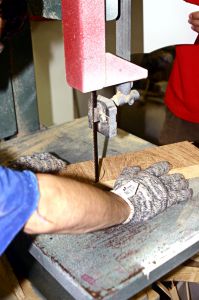 According to the United States Occupational Safety and Health Administration (
 OSHA inspectors discovered that a conveyor belt’s rotating parts were not properly guarded to prevent the hands and fingers of workers from getting caught in the mechanism. Conditions similar to this have been known to cause pinched hands and fingers, crushed or amputated hands and fingers, contusions and nerve damage. The law requires these conveyor belt systems be properly guarded so no part of an employee’s body can come into contact with moving machinery.
 Inspectors found employees working on top of a two-story residential roof without fall protection equipment. According to federal regulations, roofing workers are to be provided with fall protection equipment. In this case, they were without such safety equipment due to a deliberate failure on behalf of the employer.
 Claimant began working for employer in November of 2006. On a typical workday, claimant would see multiple patients in their respective homes. She drove her personal vehicle when going to see her clients. She would stop in the office to pick up supplies, read her mail, and attend company meetings.
 Claimant requested that employer pay for additional temporary total disability benefits and for an evaluation by a pain management specialist. Employer denied employee’s claim.
 Both claimant and employer stipulated that this was a work-related injury. Her doctor placed her on medical leave and recommended that she stop working for employer. Her doctor continued to treat her and concluded that she reached maximum medical improvement in March of 2009.